Ferrari Portofino Review
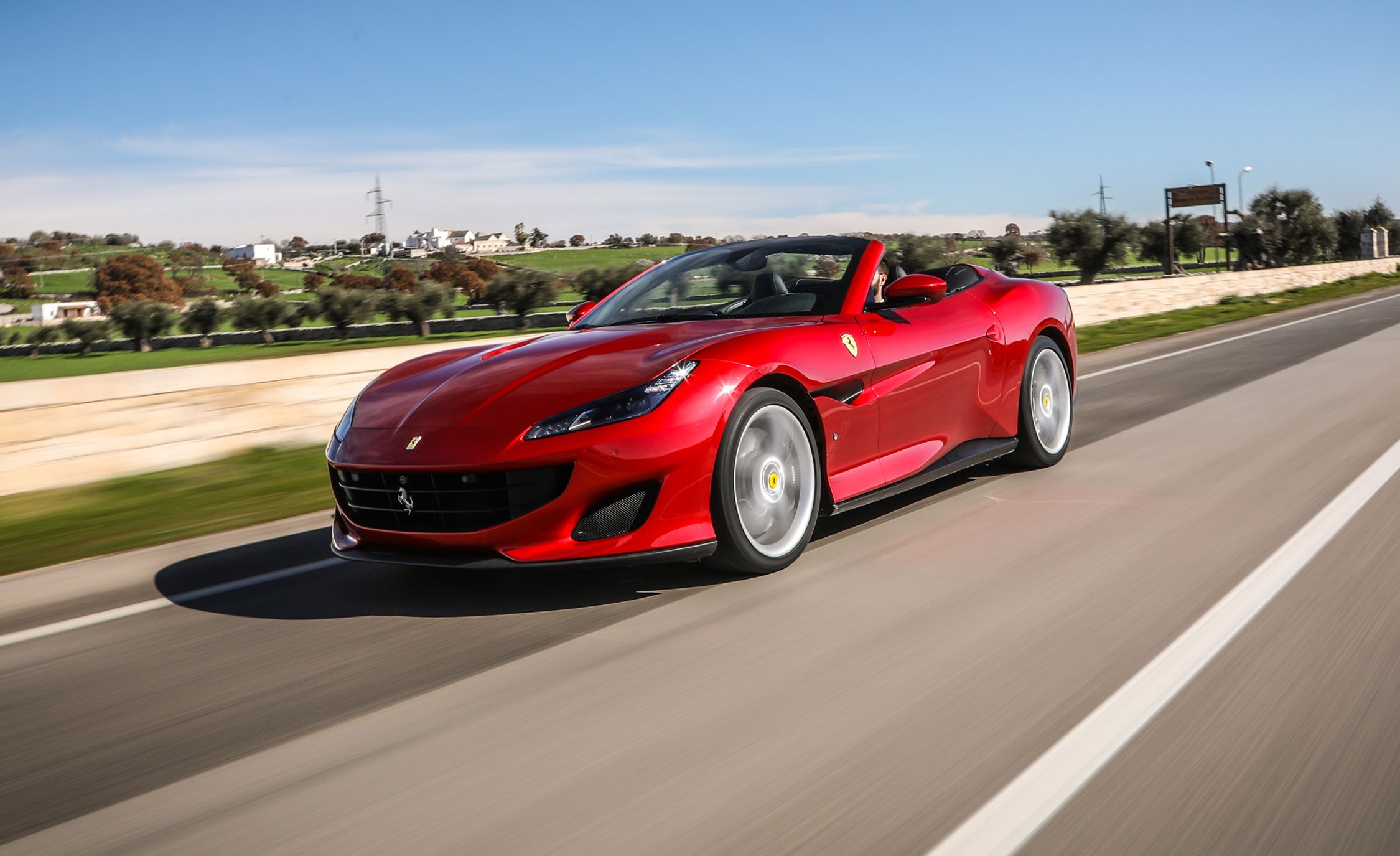
Prior to 2008, no roadgoing Ferrari had ever highlighted an eight-chamber motor in front of the driver, a double grasp programmed transaxle at the back, coordinate fuel infusion, or a power-collapsing hardtop. Those brand firsts appeared on the double on the sweet-driving California wrapped, unfortunately, in problematic styling.
HIGHS
Looks move desire, persuading as a car when important, it's a Ferrari.
LOWS
Some skeleton flex, raise seats reasonable just for kids.
Clients looked past the California's bulbous trunk to welcome the significant garbage inside: The all-season collapsing hardtop, which stowed on the roomy load hold, and that sharp-moving back transaxle. The Golden State warrior turned into the top of the line dancing horse consistently, getting a high level of new clients at its $200,000 opening cost. Ferrari designs astutely replicated their notes to its spotless sheet substitution, the Portofino, while the beauticians precisely abstained from making a second Sir Mix-a-Lot music-video additional. (The auto is named for an elegant Italian town on the Mediterranean, however the late Brock Yates would no uncertainty be regarded to see the name of the completing area for the Cannonball Baker Sea-to-Shining-Sea Memorial Trophy Dash connected to a Ferrari. You may review that he won that race with Dan Gurney in, truly, a Ferrari.)
Regardless of being just 0.1 inch lower, 1.1 inches more extensive, and 0.7 inch longer, the Portofino's look is light-years past the California's tall, slender, and to some degree sticky appearance. A couple of fairings trail off of each back seat headrest into the trunklid to separate the board's visual haul, and when the rooftop is raised, those lances nimbly convey the nursery's profile the distance to the Portofino's tail. The grille's upturned edges frame a sure smile proposing that if the California was the Ferrari you may content "U up?" in a late-night offer for a decent time, the Portofino knows it's quite enough to be the one you needed to bring home in any case.
The sprinkling of punctures in the guard, hood, and front bumpers add ligament to the structure and give a false representation of the "passage level" Portofino's more genuine equipment and goal. Thin vertical braces detachable of every fog light neglected air into the front wheel wells to constrain weight out from the wheel spokes and diminish drag. Hood vents empty motor warmth, while the detachable front admissions feed air to two intercoolers. Regardless of the more ground-breaking Portofino's higher cooling needs requesting more open frontal zones, Ferrari says its 0.31 coefficient of drag is 6 percent lower than the California T's.
It's the "Passage Level" Ferrari. With 591 Horsepower.
Furthermore, gracious, kid, that motor. It was definitely not a feeble point in the California T, and just to make sure it wouldn't be here, Ferrari gave it an extra 39 drive and 4 lb-ft of torque. Each of the 591 horses hit at redline, set apart in the Portofino at 7500 rpm. Credit amendments to the V-8's cylinders, interfacing poles, and administration programming, in spite of the fact that a lighter-weight, more liberated streaming admission additionally helps, as does bigger breadth debilitate channeling and level with length, single-piece deplete headers with coordinated twin-scroll turbochargers.
In a Ferrari first, the fumes folds are electronically controlled, not weight impelled, and, when open, they raise the motor's voice an octave or two over the baritone California T's. The Cali's seven-speed double grip programmed transmission continues with changed proportions and new alignment to coordinate with the Portofino's additional oomph, despite the fact that it currently sends capacity to Ferrari's gripped E-Diff differential, which can specifically send capacity to the back tire with the most footing.
The uneven, elusive streets of Italy's Apulia locale where we drove the auto periodically tested the E-Diff and the F1-Trac footing control framework under full-throttle dispatches. This showed in slight tail swaying, however very little wheelspin, as motor torque rearranged between the left and right back wheels looking for grasp. Our involvement with other E-Diff– prepared Ferraris on smoother, less smooth streets firmly recommends this was an Apulia issue, not a Portofino issue. Where it truly excludeed, impacting of low-speed corners, the E-Diff immaculately amplified how much motor yield was put to the asphalt.
The twin-turbo V-8 is beastly to the point that Ferrari limits top torque in first, second, and third apparatuses. From fourth to 6th, the PC oversees torque, step by step enabling more to be loosed; just seventh rigging gets the full distribution of bend. Ferrari's designers pursued that torque when tuning the transmission. At the point when left to move for itself, the double grip programmed races to seventh rigging in ordinary driving and remains there even in lower-speed city driving and in Sport mode. You won't see, in light of the fact that the motor's 561 lb-ft of torque capably moves the approximately 3700-pound Portofino even in high rigging. Or then again, as we did, you'll slap away at the metal move paddles settled to the Portofino's directing section and investigate the lower gears—and the going with lustier motor sounds. Underneath 3000 rpm, where some rambling happens, the motor is tranquil; above it, hang on.
Ferrari claims the Portofino can achieve 60 mph in as meager as 3.5 seconds, yet that gauge is as moderate as Alabama. The heavier, less ground-breaking California T required just 3.3 seconds in our testing, and the Portofino dispatches hard—torque fiddling be condemned. The straightforwardness with which we achieved 130 mph on the Autostrada abandons us with little uncertainty of the production line's cited best speed of "more than 199 mph."
Italian Riviera > the Golden State
Other noteworthy numbers? Ferrari found 176 unnecessary pounds in the California T's motor and structure and extracted them. All the more proficiently assigned welds in the aluminum body-in-white diminish weld lengths by 30 percent. Squeezed aluminum underbody streamlined pieces supplant the California's plastic, dart on boards. The power-collapsing hardtop is lighter than before in spite of being bigger and reinforced. It very well may be opened and shut at velocities down to 25 mph; doing as such resembles opening a drag chute.
Ferrari says the lighter body additionally is 35 percent stiffer, despite the fact that we noticed some mellow cowl shake on uneven asphalt with the best brought down and some undercarriage flex while entering steep carports. Those bugaboos have no evident impact on the suspension's competency. Ferrari claims the springs are 15.5 percent stiffer in front and 19.0 percent firmer in back, bringing the standard setup to about indistinguishable level from the California T's discretionary taking care of bundle. Versatile magnetorheological dampers are again discretionary, and they're so great they should be standard. Flick the directing wheel-mounted manettino driving-mode switch among Comfort and Sport, and the dampers convey a created ride and unequaled body control in any case.
Just the second Ferrari with electrically helped controlling (after the 812 Superfast), the Portofino uncovers that the automaker is as yet dealing with its framework. The directing, which is 7 percent snappier than the California's rack and has a fantastic on-focus valley and agreeably light exertion, jerks the Portofino into corners like a Taser to the quarter-board. However, it never transmits that last particle of input that electrically helped Porsche racks do. Your inward gyro compensates for any shortfall, helped by the Ferrari's back one-sided weight circulation (54 percent of the mass is professed to sit on the back hub) and surfeit of front-end grasp. At the point when the tail starts to slide—something it'll do as promptly off-throttle as on—the activity is continuous and effortlessly distinguished. The standard carbon-artistic brake rotors offer reassuringly solid ceasing power for settling misjudged butt signals and, after a concise best of-pedal squish zone, a firm pedal feel.
Ferrari's most recent infotainment framework procures a get out for reacting instantly to inputs and being genuinely simple to explore. A discretionary touchscreen sits on the dash before the traveler, empowering your co-pilot to see speed, equip choice, and other execution measurements—or to adjust route waypoints and send them to the focal and driver shows. The front seats, with more slender casings recently rendered from magnesium, are especially agreeable and leave a skosh more space for back seat riders' knees. With the best raised, the Portofino is coupelike calm, and you can fit three portable roller packs in the storage compartment. So it's as ordinary helpful and phenomenally athletic as the California, with less firsts. The one that tallies most with us? It's the first traditionally truly, front-motor, eight-chamber, collapsing hardtop Ferrari.


Comments
Post a Comment