The 2019 Hyundai Kona Electric
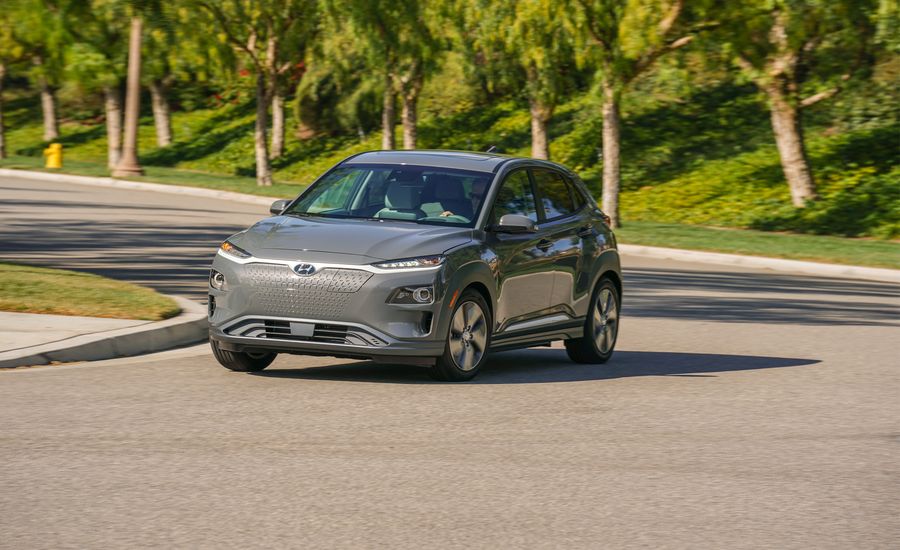
On the off chance that you are thinking about an electric vehicle, you should need to draw up another shopping list. What's more, you ought to most likely pencil in the Hyundai Kona Electric on the main line. The fuel consuming Kona is among the best subcompact hybrids available, with audacious styling, a great accessible turbocharged motor, and brilliant driving elements. The battery-controlled variant duplicates down on every one of these attributes. It is all the more dumbfounding to take a gander at, its outline somewhat less outgoing than that of the standard Kona. The electric engine delivers more power and significantly more torque than the inside ignition motor in even the highest point of-the-line turbocharged Kona. What's more, a lower focal point of gravity gives the Kona Electric a physicality that is uncommon in this class of vehicle.
HIGHS
One-pedal driving, long range, improved physicality.
LOWS
Soft brake pedal, powerless charging framework, smallish inside.
You can detect the electric form by its front sash, which has just the deception of a grille, behind which hides its charging port and a helpful condition of-charge marker. The cladding around the headlights of the standard Kona has additionally been expelled, which tidies up the front end pleasantly. Inside, the progressions are more self-evident: The shifter has disappeared, supplanted with push-catch transmission controls on a raised focus support that additionally contains a couple of cupholders and conceals an open stockpiling region underneath. Critically, the electric form of the Kona was arranged from the beginning, so none of its powertrain barges in on the lodge or the load hold. Traveler volume and payload space estimations are relatively indistinguishable to those of the fuel variant, which means the Kona Electric has a fairly confined rearward sitting arrangement and can't swallow much baggage. It is, all things considered, a subcompact hybrid that is only 164.6 inches in length.
What Makes It Go
Under the Kona Electric's hood sits its 201-hp perpetual magnet synchronous AC engine, or, in other words a solitary speed, front-wheel-drive transaxle. Contrasted and the turbocharged 1.6-liter inline-four accessible in the standard Kona, the electric adaptation's 201 strength and 290 lb-ft of torque speak to increments of 26 horses and 95 lb-ft. This is more torque than its 17-inch front tires can deal with now and then, and a forceful dispatch will initiate the footing control. Hyundai says the Kona Electric can achieve 60 mph in 7.6 seconds, mirroring this footing constraint and in addition an expected 3750-pound control weight. However, passing speeding up is very solid, and the Kona Electric's energy is supplemented by forceful regenerative braking.
Hyundai has conveyed a driver-selectable regenerative-braking setup like the one in its Ioniq EV. Oars behind the controlling wheel enable the Kona Electric's pilot to go through four levels of regen—in addition to a fifth greatest mode that tops out at 0.25 g of deceleration, as indicated by Hyundai, yet just when holding down the left oar. This takes into account genuine "one-pedal" driving that could be more captivating than Tesla's, notwithstanding Hyundai's utilization of mixed braking. While Tesla permits the brake pedal on its autos to control the grinding brakes freely of the electric engine's recovery, Hyundai, as most carmakers, demands utilizing the brake pedal to initially start the deceleration that accompanies electric recovery before step by step mixing in rubbing braking. This makes it hard to discover the point in the movement at which the brake pedal begins working the real brakes. Hyundai likewise offers a programmed mode that shifts the level of recovery to deliver a predictable rate of deceleration paying little mind to street level; turning it on gives the Kona Electric an inclination while drifting that is like that of an interior burning vehicle amid motor braking.
Driving Impressions
In spite of the fact that the Kona Electric's 6.2 creeps of ground freedom (0.8 inch not as much as the standard adaptation) won't make it quite a bit of a stone crawler, a greater amount of its mass sits lower, improving it feel associated with the street. Covered up underneath the floor, the 64.0-kWh lithium-particle battery pack moves the Kona Electric's focal point of gravity 3.6 inches nearer to the asphalt, to 20.3 inches, as per Hyundai. That is sports-auto region. While this doesn't transform the Kona into a games auto, it makes the little hybrid amusing to hustle down ravine streets, particularly in its Sport driving mode, which adds some weight to the controlling and livens up the engine reaction.
The Kona Electric has three other driving modes: Normal, Eco, and Eco+. This last one is for utilize when run tension swings to extend edginess, stopping the atmosphere control framework to boost miles. It appears to be improbable that this component will have much utility, given that the Kona Electric flaunts a 258-mile EPA run gauge. This is right now the longest of any non-Tesla electric auto, prevailing over the Chevrolet Bolt (238 miles) and in addition the new Jaguar I-Pace (234). Furthermore, if Tesla ever gets around to offering its base-powertrain Model 3—the "$35,000" one—the Kona Electric should put that Tesla's 220-mile range to disgrace also.
Connecting To
The Kona Electric conveys couple of provisos. None of the mechanical corner-slicing different makers have utilized to diminish costs is available here—its battery pack has a fluid warming and cooling circuit to enhance proficiency and conveys what Hyundai is calling a lifetime guarantee. All Kona Electrics are outfitted with a 7.2-kW locally available charger, and they all help DC quick charging too, in spite of the fact that the SAE Combo Charging System that Hyundai utilizes is no place close as regular as Tesla's restrictive Supercharger system, and couple of CCS stations today can charge at the most astounding, 100-kW rate. The Kona Electric is all around prepared, including standard nearness passage, warmed seats, two USB ports, Apple CarPlay and Android Auto similarity, and Hyundai's BlueLink associated auto framework that enables proprietors to remotely control charging and atmosphere control settings with a cell phone. It appears to be worth making reference to again that the Kona Electric is a subcompact hybrid, a vehicle compose at present encountering a ubiquity matched just by brew and YouTube feline recordings.
At the point when the Kona Electric goes discounted in mid 2019, we expect it will begin at about $37,000—before the $7500 government charge credit. Hyundai says it will offer the Kona Electric in California first and after that extend deals to the next CARB states. (Purchasers somewhere else ought to have the capacity to arrange one.) Coincidentally—or maybe not—the Kona Electric lands in the principal quarter in which Tesla purchasers will see their expense credit lessened by 50 percent, the start of a yearlong eliminate in which it is sliced down the middle again in July. The entry of such a top notch, long-extend electric vehicle, one that is really reasonable, ought to be sufficient to entice in any event a portion of those starry-looked at visionaries sitting tight for an ease Tesla. Or on the other hand any other individual, so far as that is concerned.


Comments
Post a Comment