The Real Deal: 1965 OVC Shelby Mustang GT350R Continuation Series Driven!
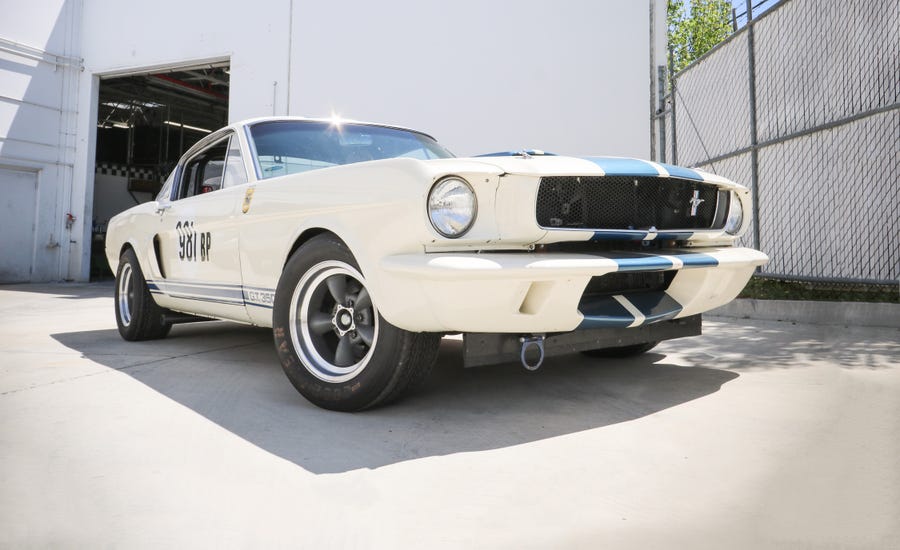
Scarcely any cars are as mixed with the wistfulness of 1960s auto culture as much as the 1965 Shelby Mustang GT350 Competition display, a.k.a. the GT350R. The Shelby-adjusted Ford Mustang took checkered banner after checkered banner in SCCA Class B races from its first excursion and for a long time thus, legitimizing the Mustang as an execution machine and inciting General Motors and others to quick track horse autos of their own.
HIGHS
Fabulous form quality, road lawful and track prepared, Shelby serial number, overhauls as bona fide as the auto itself.
LOWS
Intermittent whiplash, quarter-million-dollar value, influences a Kia Rio to feel rich.
Hagerty Insurance appraises the estimation of a unique GT350R at amongst $700,000 and $1 million, so regardless of whether you have a vintage GT350R, odds are you wouldn't have any desire to cry on it at the track each end of the week. A reproduction would possess all the necessary qualities—and they're out there—yet would it truly drive like the first?
The general population who might know best would be the general population who really manufactured the firsts. Also, they're out there, as well. Even better, some of them have joined together to frame Original Venice Crew (OVC) Mustangs, to construct a "continuation arrangement" of 36 extra '65 Shelby Mustang GT350 Competition models for utilize both in the city and the track. The autos can be spec'd either precisely just like the firsts or with a few updates that are said to have been in growth in 1965 be that as it may, for some reason, weren't on the GT350R when the FIA confirmed the auto in February 1965, in this manner solidifying its plan and details.
We went to OVC's Gardena, California, shop—situated inside a Shelby office, by chance—to get the full story from its CEO, previous Shelby American workman and fabricator Jim Marietta, and to get a little seat time in his own OVC Mustang GT350R. We entered the experience to some degree suspicious of the reproduction's genuineness. We left away persuaded of its provenance as well as trusting that we had quite recently determined something far superior to the most flawless GT350R one could discover.
The Idea
The first expectation was to construct only one. Marietta was just 17 on January 2, 1965, when he began taking a shot at GT350Rs as a technician at Shelby American's shop in Venice, California. He says it was late in 2013 when the "constant stream of thoughts and contemplations" about building one more GT350R started, first at a gathering of Shelby workers and proceeding at the yearly SEMA party facilitated by incredible racer and auto fashioner Peter Brock (who penned the first GT350R's sundry adjustments, among his different credits). Marietta eventually enrolled Brock and kindred Venice group repairman Ted Sutton to change one more "K-code" Mustang GT fastback, with its elite 271-hp rendition of Ford's 289-cubic-inch V-8 and four-speed manual, into a GT350R that Marietta would at last keep for himself.
The procedure wouldn't be simple however could be fun, he figured, including finding or potentially manufacturing whatever was important to duplicate the first's bodywork; stripping the inside and introducing the same simple arrangement of measures, period dashing seat for the driver, and the stock traveler situate; tying down the extra tire on the bundle rack where the back seats used to be; goosing the motor to Shelby specs; and painting the entire thing Wimbledon White with Guardsman Blue stripes.
"The first start was to assemble it as close as conceivable to the way we completed 50 years back, with similar individuals, and have it play out a similar way," said Marietta, who in the wake of working at Shelby American went ahead to end up a bookkeeper and the proprietor of numerous private ventures. He hadn't yet viewed as enhancing the GT350R—or building more than one. Be that as it may, another Mustang fan got expression of his designs, and soon one wound up two.
The Upgrades
At that point Brock ringed in. Brock's unique adjustments to the '65 GT350R are notable to Mustang fans and incorporate hand-beat raise bumper flares to clear more extensive tires; a hood scoop; plain back quarter-window boards instead of the GT's louvers; a mind boggling "humpback" plexiglass raise window that made a space under the rooftop for ventilation; and an awkward air allow in the front end that seemed as though somebody tossed a block through the non-R auto's nose. On the off chance that it looked somewhat slapdash, that is on account of it was, actually, incomplete.
As indicated by Marietta, quite a bit of Brock's GT350R work was left on the planning phase—truly—when Shelby's shop moved from Venice to El Segundo while Brock was in Italy on another Shelby task. "Subside says to me, 'You know, I had this stuff on my planning phase . . . what's more, when I got back, the auto was so far down the line that no one needed to transform it,'" Marietta reviewed.
With the GT350R's unique creator offering to complete what he had begun, subsequently demonstrating the world how he implied for the auto to look from the start, Marietta chose that specific things that were excluded on the first GT350R could be made inasmuch as they were being developed at the time. Eventually, a suite of redesigns—not to be mistaken for refreshes—were made to his auto, and each is offered on the client cases also.
Advantageously, amid our visit the OVC shop contained one auto that was rendered precisely like the first (it's bound for an European client who means to enter it into FIA vintage-dashing occasions), notwithstanding Marietta's auto, which includes the greater part of the updates. The unobtrusive visual changes give the auto a substantially more entire look. The GT350R simply got a midcycle improvement, simply following a 50-year break.
Boss among the progressions incorporate the back window. While the first's humpback plexiglass raise window ventilated the lodge, it seriously misshaped rearward vision. In addition, it looked entertaining. "Subside stated, 'If this had returned from the shop like this I'd have sent it back. This isn't the means by which I composed it.'" Marietta focuses to his auto's new back window, which is both compliment and set at a compliment edge. "That is the thing that Brock had initially imagined in 1965."
Brock likewise reincorporated a front guard over that vast throat, all the while giving the nose a more completed appearance and better focusing on wind current to particular motor segments, as per Marietta. The roundabout gaps in the first belt were reshaped into vertical openings to guide cooling air to the front brakes by means of new metal channels. Side scoops cut into the body toward the back of the entryways play out a similar capacity for the back brakes by means of ventilation work of their own. The back quarter-windows that supposedly weren't prepared in time for the GT350R's first run have discovered their direction onto it this time around. Everything else you can see and contact stays as it was in 1965.
The Engine
At the time, the standard Shelby GT350's 289-cubic-inch V-8 made 306 pull, and the GT350R kicked it up to a strong 360. That was fearsome power in those days, however with the present base Mustang getting 310 ponies from a four-chamber and the GT350R's 2018 namesake drawing out 526, it's not really amazing that OVC needed more. In particular, it utilizes a Shelby Race Engines press square factory that basically is the same 289 that accompanied the K-code, improved utilizing jolt on parts with no inward changes—like the way control was tightened up in 1965. The redesigns themselves are extraordinary, nonetheless, and incorporate electronic start, aluminum heads, an opposition camshaft, and a "stroker" crankshaft that raises relocation from 289 to around 331 cubic inches.
Open the hood (which you'll likely be requested to do at whatever point you stop this auto) and even the most enthusiastic Mustang aficionado will be unable to tell that the OVC auto's motor, with its aluminum valve covers and hand-framed admission plenum the measure of a blending dish, is any unique in relation to the original's. In any case, extraordinary it is, delivering a more respectable 460 steeds, joined by 420 lb-ft of torque in an auto weighing under 2800 pounds.
"These changes are a typical movement that, probably, would have advanced at Shelby's race shop too," Marietta says, declaring the auto's legitimacy in spite of the power increment, which has provoked an as yet progressing scan for a more strong four-speed manual transmission than the Borg-Warner unit that accompanied the first.
Idealists may sneer, however given that OVC still uses a Shelby motor in light of the 289, we're not very concerned. All things considered, race autos are frequently works in advance, and drivers explore different avenues regarding new segments constantly. Furthermore, for anybody extremely worried about correct replication, OVC is glad to fabricate the motor to FIA-endorsed specs.
The IRS
Marietta raises his auto up on a crane, calling attention to its beefier front shafts, thicker front brake circles, and—the most huge mechanical overhaul of each of the—a free back suspension (IRS) that had been proposed for the first Mustang however purportedly was retired before it was done because of worries about generation costs. He and Brock chose that, while they were completing so significantly other stuff left fixed on the first GT350R, they should put the IRS on his auto and complete that activity, as well.
As per Marietta, the first autonomous back suspension had been designed for generous road utilize, leaving the auto for the most part inclined to understeer while making things "a little squirrelly" at the cutoff. With the assistance of three eminent test pilots—ebb and flow Shelby American VP Vince LaViolette; previous Shelby racer and 24 Hours of Le Mans class champ John Morton; and Rick Titus, child of Shelby hotshot driver Jerry Titus—Marietta and friends finished the designing work left fixed 50 years prior. "Presently it's nonpartisan," he said. "When we did that, everyone thought it was incredible."
The two Mustangs appeared at a Los Angeles Shelby American Automobile Club (LASAAC) occasion in mid 2015


Comments
Post a Comment