Acura NSX
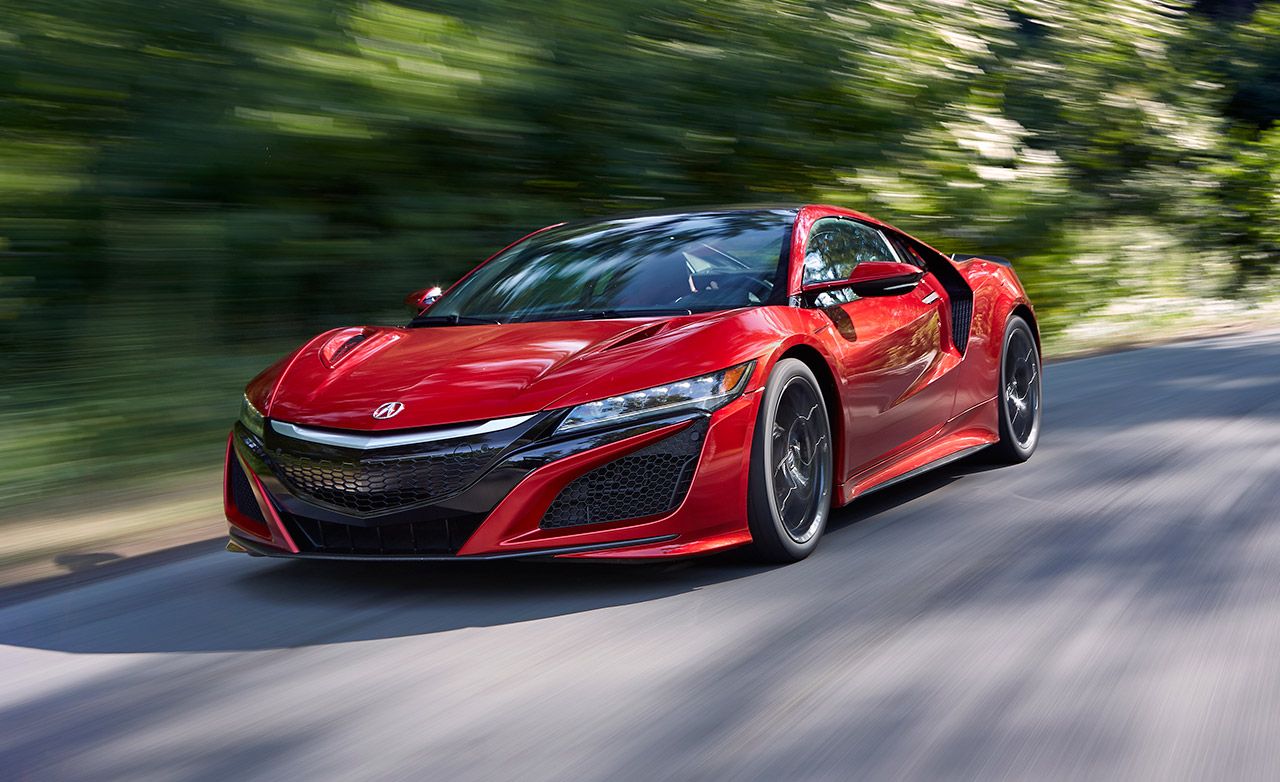
In the event that a 3868-pound, all-wheel-drive crossover strikes you as an inquisitive continuation of the first bantamweight NSX, you're not the only one. As vehicle-execution lead design Jason Widmer lets it know, the underlying prospect of a gas-electric NSX caused as much hand-wringing inside Honda's passages as cocked eyebrows outside them. In the beginning of the new auto, NSX donkeys reliably set down speedier laps without the battery-electric help framework that should make the thing faster.
HIGHS
Ready body, indications of life at Acura.
LOWS
Electric help smooths the show out of 573 drive.
Decision
The fate of performance autos, still in beta.
That was over five years back, and the NSX's half and half electric framework is presently a completely created bit of go-quicker pack. The auto taking off of Marysville, Ohio, flawlessly consolidates two turbochargers, three electric engines, four driven wheels, six barrels, and nine forward apparatuses to deliver real supercar execution. That won't make it any less disputable; there are an unending number of thoughts with respect to what a revived NSX ought to have been. The idea that won out is a moving proving ground for the eventual fate of execution innovation. "You won't discover an auto in this class in 10 years that won't have charge. I'm sure on that," Widmer says.
VIEW 51 PHOTOS
So are we. The NSX isn't the first of its kind to work electrons and hydrocarbons in the quest for speed, however give Acura acknowledgment for so quickly democratizing the innovation. Indeed, even with a beginning cost of $157,800, the NSX is hard confirmation of the sort of stream down financial matters that really works. Yielding a small amount of the execution and the unadulterated electric driving ability of the 2015 Porsche 918 Spyder got Acura a $700,000 value cut for its mid-engined legend.
Widmer may have been discussing McLarens, Lamborghinis, and Ferraris when he made his 10-year expectation, however the jolt of execution won't stop at supercars. Opposing material science, the electrons are ready to stream into famous execution autos where there's much more opposition. Hybridized 911s and BMW M3s are an outcome, not only a probability. This NSX is a see of things to come.
VIEW 51 PHOTOS
Our test auto landed with $11,860 worth of tire and brake overhauls. The base NSX wears press brake rotors and less forceful summer tires.
For Acura, the half and half framework that supplements the 500-hp V-6 plays consummately to the character of the NSX, both old and new. Much the same as the first, the cutting edge NSX is just as acculturated as it is fast. The open sightlines, the wide lodge, and the seats that suit the normal American are as eminent in this class just like the electric engines that give it moment off-the-line push. It's a supercar without a God complex, as honest as an auto with a motor behind the driver and a six-figure cost on the window can be.
More than some other current auto, the NSX is a result of whichever of its four modes—Quiet, Sport, Sport-Plus, and Track—is dynamic right now. Alongside the typical adjustment changes to the electrically helped directing, versatile dampers, and soundness control framework, the NSX goes up against an alternate persona relying upon how it mixes inner burning and electric push.
Not That Sporty: Sport Mode
Since there's not all that much around a 573-hp, torque-vectoring, gas-electric mid-engined Acura, engineers named the NSX's default road mode "Game." It strikes us as a misnomer, however, in light of the fact that getting the NSX to quicken eagerly in this mode requires huge, consider throttle inputs. It's most appropriate to urban settings, where the low-end torque of the electric engines—two in advance and a third, bigger unit mated to the motor—pulls the NSX off the line speedier than activity, yet without turning the motor much past 3000 rpm.
The motor cover fashioner obviously grew up adoring Jiffy Pop. The stiffer of the two suspension settings is excessive for open street driving.
The undercarriage is constantly alert regardless of whether the powertrain isn't. With $1960 worth of Pirelli P Zero Trofeo R tires sticking the wheels to the asphalt, our test auto loyally transmitted each moment guiding contribution to the street paying little mind to the mode. Indeed, even as the directing weight increase with the more forceful settings, the NSX turns in with enthusiasm and exactness. Most noteworthy, the NSX never gives a false representation of its weight, regardless of how quick the speed or how sharp the corner. Turns feel easy, and as long as the asphalt is smooth, the body stays level.
That body is as much a cross breed similar to the powertrain. It's made basically of aluminum castings, stampings, and expulsions, yet the A-columns, rooftop pillars, and windshield header are altogether made of steel, which means there is more ferrous metal in the body of this NSX than in the 27-year-old unique. The front sections of flooring are the main basic carbon-fiber bits, despite the fact that $21,600 will purchase simply enough carbon fiber to reskin the rooftop, motor cover, splitter, ledges, diffuser, and spoiler as observed on our $202,960 test auto. The external boards are a blend of framed aluminum and shaped plastics.
Not That Quiet: Quiet Mode
Contrasted and the unassuming Sport mode, Quiet mode is the self-destroying, relatively remorseful approach to pilot a low-threw, Valencia Red Pearl– painted origami supercar through a group; it slaughters the V-6 at whatever point conceivable. It isn't, be that as it may, a genuinely quiet mode. The motor still flames when you begin the auto in Quiet mode, however it revs just as high as the 1500-rpm quick sit out of gear and sounds as wild as a Honda Odyssey minivan warming its catalysts. Once the powertrain is hot, Quiet mode to a great extent carries on like a forceful stop-begin framework.
In the event that you were hoping to cut through town with the quick, quiet moves of a Tesla, you'd be disillusioned. With a little lithium-particle battery pack (Acura will just say its ability is "roughly one kilowatt-hour") and not as much as a Honda Civic of strength from the electric engines, the NSX once in a while gets above strolling speed without terminating the motor. It likes to ride the 3.5-liter V-6 to cruising rate and after that sail on electrons up to 50 mph when the street is level or downhill.
Calm mode doesn't diminish the suspension or help the directing. It's simply a dimmer switch for the gas motor, moving more work to the electric engines and practicing the battery harder. The NSX refutes any endeavors to drive hard in this mode. It incapacitates the oar shifters and makes the transmission short-move at 4000 rpm when the quickening agent is pegged. And keeping in mind that Quiet mode cuts back the volume both inside and outside the auto by shutting the fumes sidestep valves and the admission resonator pipe, it barely feels serene from the driver's seat. The steady on-off-on of the motor rapidly ends up tedious.
Awakening the NSX: Sport-Plus Mode
The conspicuous panacea is Sport-Plus, in which the gas motor never stop and we never observed the nine-speed transmission change higher than 6th gear individually accord. Game Plus redraws the tachometer to cover 9000 rpm, as opposed to 8000, however the redline stays unaltered at 7500 rpm, which is likewise where the supported V-6 makes its pinnacle 500 drive.
The motor's surprising 75-degree V point brings about a shorter and in this way fortified crankshaft in respect to a 60-degree outline, and a smaller general width contrasted and a 90-degree unit. Produced internals incorporate the crankshaft, interfacing bars, and valves. Fuel is infused on the other hand into either the burning chambers or the admission ports to amplify both power and proficiency. However the motor never sounds nor drives as fascinatingly as it peruses on paper.
That is the reaction of execution improving electric engines. They smooth the power conveyance to the point that they cover the full commitment of the gas-nourished motor. Level the quickening agent and the NSX mixes the engines, the turbos, and the responding cylinders into a course of low-end torque, midrange lift, and top of the line control. In the event that you could isolate the sensation from the admission reverberation tube singing simply behind your skull, it would summon the underlying torque swell of an electric vehicle with the apparently unending draw of a 9000-rpm Porsche. Notwithstanding amid part-throttle shifts, gearchanges enroll entirely perceptibly, with the engines veiling the fleeting blip in gas-motor torque. Our VBOX test hardware, which logs information 100 times each second, neglected to distinguish any loosening in the speed follow when the transmission moved.
Left in programmed mode in Sport-Plus, the gearbox will downshift under braking, however not forcefully. The transmission likes to keep revs in the vicinity of 3000 and 4000 rpm, and it feels more normal to locate the correct apparatus all alone with the oar shifters. And still, at the end of the day, the transmission regularly denies the last downshift into first rigging as you moderate for a stop sign, and it's just as you step on the quickening agent that you find the irritation of as yet being in second.
Acura opposed the compulsion to give a different damper adjustment to each drive mode, which is fine by us. The Germans frequently get buried in making a different yet also traded off tune for each drive mode. In view of feel alone, Acura's two settings utilize a genuinely slender segment of the transmission capacity managed by magnetorheological dampers, with one position covering Sport-Plus and Track modes and a milder tune for Quiet and Sport.
While the gentler position pleasantly balances ride quality and body control, the stiffer position demonstrated excessively on our 10Best circle. The NSX skirted knotty areas, the motor revs surging and drooping as the back tires moved amongst light and stacked, which is agitating hecticness that saps certainty. Game mode's more consistent damping kept the body planted and permitted a speedier pace over a similar stretch of street. Tragically, there's no real way to decouple the damper settings fro


Comments
Post a Comment