2019 Ferrari 488 Pista
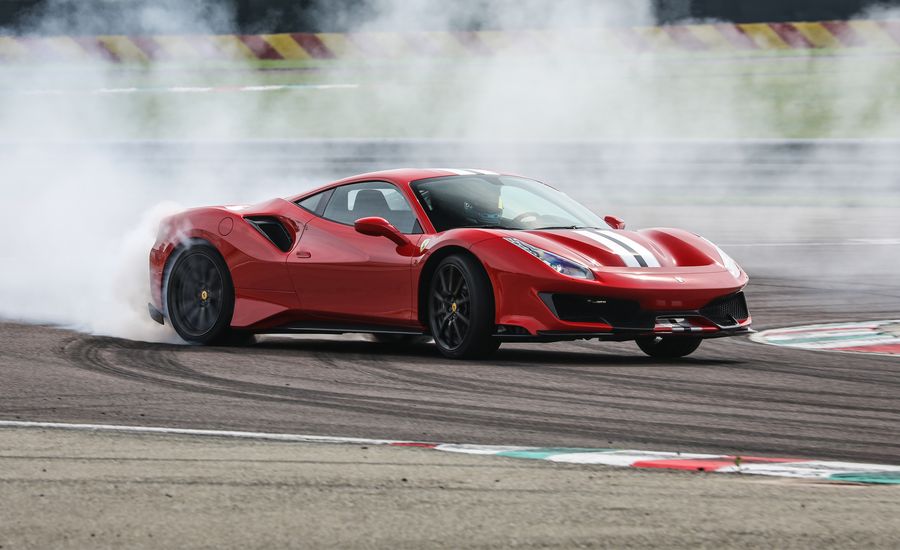
I simply had some genuine alone time in Maranello with a Ferrari 488 Pista, an auto that will begin at $350,050 when it arrives this winter. Ferrari's just directions were to go drive and be back in time for lunch at Ristorante Cavallino by the plant. Press dispatches are never this laid back, and there's constantly another media part along as a drive accomplice who needs to tune in to your babble, but at the same time they're sitting tight for their opportunity to drive, prepared to take your seat time.
HIGHS
Takes the 488 to the following level of execution, still brilliant in the city, so lovely.
LOWS
We'd like more shout and less bark from the motor, we're inadequately affluent to cut the check.
Without a traveler to converse with, I'm left with questions bobbing in my mind, which you currently get the opportunity to hear. Like for what reason do individuals open the shades on planes when there's turbulence? Is it true that they are hoping to see a development group? Or on the other hand, when precisely in our lives does a coverall turn into an overskirt? I think it occurs around age 10.
Alone time can be exceptionally uncommon, however, and the 488 Pista is so speciale.
But it's not called Speciale. It's the 488 Pista—pista is Italian for "track"— and it's the fourth in a line of restricted release, track-centered forms of Ferrari's mid-motor V-8 two-seaters. The first was the 2004 360 Challenge Stradale, an auto so great it influenced you to feel like you should accomplish more with your life. Next came the 430 Scuderia, another stripped-down, incredibly speedy and uncommon Ferrari that we tried in Italy in 2009 as a feature of an examination test with an Audi R8 V10. That Scuderia didn't have floor mats or windows that opened. The Audi did. The Audi lost. The 458 Speciale took after. It more than satisfied its name.
A large portion of a Transplant
With the last diesel-burping Iveco truck off the beaten path, my brain goes from considering new email passwords—I'm route past my puppies and onto my companion's pets—and spotlights on the intensity of the Pista's motor. A dry-sump twin-turbocharged 3.9-liter V-8 jolts somewhere down amidst the auto. Contrasted and the core of the 488GTB whereupon the Pista is based, 50 percent of the Pista motor's parts are new. A lighter crankshaft and flywheel hurl lighter titanium interfacing bars with an asserted 17 percent diminishment of idleness. The pressure proportion ascends from 9.4:1 to 9.6:1, and more forceful cams work with shorter admission sprinters and another Inconel ventilation system that decreases backpressure and measures 21 pounds not as much as the GTB's thrown unit. Ferrari found an extra 49 torque and dropped about 40 pounds from the V-8. Altogether, Ferrari claims a 176-pound weight lessening versus the GTB. Select the carbon-fiber wheels, a Ferrari to start with, and the weight drops by another 22 pounds.
The motor's 710 drive doesn't simply arrive, it bursts in and puts its hooves on the end table. Power doesn't crest, it levels. From 6750 rpm to the 8000-rpm redline, the V-8 keeps on making the greater part of its 710 pull. Redline shifts from first to second to third never dip under 6750 rpm, so even after a move you're still in the place where there is 710 drive. Dispatch control is incited by a Launch catch on the LaFerrari-like carbon-fiber outcropping that sprouts from the inside support. Push the catch, at that point hold one foot on the brake and the other on the quickening agent, and the Pista will rev the motor to 3000 rpm before departure. In case you're not prepared for it, your head won't stand a possibility. Despite the fact that the Pista sends torque just to the back wheels, the watchful tuning of the torque bend, control conveyance, and accessible footing are an educational match that considerably Tinder couldn't make.
To begin with adapt doesn't keep going long, however what's odd is that second rigging is gone instantly also. Second passes so quick that we needed to think about some video to perceive what happened. It's difficult to assess an auto when an intense instance of the laughs goes with each hit of the pedal to the metal. It's really metal, as well, as the Pista can be spec'd with an exposed aluminum floor that'll tink with each stone hurled up by the Michelin Pilot Sport Cup 2 elastic. (The Scuderia did that, as well.) Although it pegs our own chuckle meter, Ferrari's speeding up cases may be of more intrigue. What about a credible zero-to-124-mph time of 7.6 seconds? We'd expect a sub-3.0-second rushed to 60. Another favorable position of going solo: With no traveler along, there's nobody to feign exacerbation when you complete seven back to back dispatch control begins. It might have been 10.
Pista Particulars
Indeed, even on broken asphalt, the about 8-to-10-percent-stiffer springs stay bearable. The lumbar protuberance in the carbon-fiber seats is unquestionably irritating. As in the 488GTB, magnetorheological dampers smooth the edges off knocks. Inside space is shockingly tremendous, and the view out is all encompassing. Generally, the overwhelming visuals come when you're outside the thing. Another carbon-fiber front guard motivated by that of the 488 Challenge race auto basically puts a wing between the headlights to increment downforce. A carbon-fiber spoiler in back further presses the Pista onto the pista. An adjustment in the introduction of the front radiators enabled designers to change the wind current around the guard to additionally increment downforce. On the back bumpers, bigger openings are devoted exclusively to the intercoolers. On the GTB, a littler opening in a similar area nourishes the intercoolers and the motor's admission. Here, the motor air admissions are moved to underneath the edges of the back spoiler as in the Challenge racer.
Light guiding and that trademark 488 driving position that sets you straight up against the front-hub line encourages the certainty to push increasingly hard. There's nothing a mountain street can toss at the Pista that disrupts it. Tight stuff, fast stuff, midcorner knocks, brisk forward and backward advances, and spandex-wearing cyclists all are taken in walk. Be that as it may, despite the fact that its breaking points are high, the auto never acts exhausted in the city. Driving it beneath its potential in the city is as yet an excite in light of the fact that the directing, brakes, and powertrain all sing a similar tune and you're there shrieking along. One more favorable position of driving alone: No one needs to hear you shriek.
Fiorano Fun
At Ferrari's Fiorano test track, a 12-corner pista that presently is about encompassed by lodging, the 488 Pista at long last uncovered that there are, truth be told, cutoff points to its footing. Another framework named Ferrari Dynamic Enhancer (FDE) works from various perspectives like a soundness control framework, however as opposed to attempting to prevent the case from splitting ceaselessly, the framework utilizes singular brake applications to smooth out the loss of grasp in corners. Riding and surpassing the utmost is weakened and backed off so the driver can discover and even surpass the point of confinement of bond effortlessly, less exertion, and without ruining any clothing. Turning into CT Off mode initiates FDE, which is one stage from ESC Off, and it's that mode that can possibly leave skidmarks on something other than the street.
Leaving those imprints on the black-top are recently created Michelins. The up and coming age of Ferrari-spec Michelin Pilot Sport Cup 2 tires (assigned by "K2" shaped into their sidewalls) highlights elastic that has been intended to expand dry footing and circuit strength while keeping up some wet capacity. The tires were splendid in the city. At the point when the designated track time arrived, the tires had seen some manhandle and surrendered somewhat sooner than we anticipated. In any case, the FDE did its activity, permitting minimal backside slides that are as effectively gotten as they are unsurprising. (It additionally worked splendidly on an icy and wet Fiorano amid our model drive of the Pista.) The hot tires don't help for the brakes, however. The amazingly firm pedal feel is enchantment obtained from the Challenge race autos and decreases the pedal stroke; all things being equal, there's no blaming the brakes in the city. On track, hot front tires extend braking separations lap to lap, yet I'm not here to beat the Pista's legitimate 1:21.5-second Fiorano time, a simple two seconds behind the LaFerrari hypercar.
There's extremely no real way to set a lap in any case, as Ferrari's track is liable to sound-level points of confinement, and there's a major sign on the straight that says, "Gas Off," which influenced me to hold one in. The Pista is absolutely sufficiently boisterous to peg Fiorano's sound-level meter, and we're glad that the new ventilation system blows a racier tune than the 488GTB's thrown unit, yet we miss the normally suctioned V-8s of the ongoing past; the Pista is about that bass. Ferrari's normally suctioned V-8s yelled and growled into the redline. The Pista barks and thunders its way there. Those turbochargers have changed the sound, yet Ferrari increased the motor volume inside. Sound quality is essential to Ferrari, and the Pista is unmistakably part of a continuous test managing the dulling impacts of turbocharging.
With Ferrari time over, it has returned to the inn to compose. Composing is a lone gig. So I'll ask: Who purchases plain yogurt and why? Have any of you seen that Sábado Gigante was extremely just Hee Haw for Latin Americans? I believe I'm done here.


Comments
Post a Comment