2018 Ford F-150 3.0L V-6 Power Stroke Diesel
With regards to pickup trucks, the choice to go diesel is for the most part a basic one: If you pull overwhelming burdens or potentially tow trailers all the time, there is not a viable alternative for the certainty rousing muscle and low-end torque of a pressure start motor. The incremental changes in mileage that you'll additionally increase simply sweeten the arrangement. The new 2018 Ford F-150 with its discretionary 3.0-liter V-6 Power Stroke turbo-diesel, in any case, flips this equation on its head.
HIGHS
Smooth and direct power conveyance, calm activity, mileage.
LOWS
Less pull and torque than the 3.5-liter V-6 EcoBoost, value premium.
For significantly more profound scope of the Ford F-150, see our Buyer's Guide top to bottom audit.
In spite of the fact that it now wears a Power Stroke identification, the 3.0-liter V-6 has a universal family. Normally alluded to as the Lion motor, it was together created by Ford with PSA Peugeot Citroën years prior and is at present utilized as a part of some Land Rover items. We beforehand definite how Ford beefed it up for residential truck obligation, yet here's a short refresher: The square is a compacted graphite-press throwing, and new parts incorporate a produced crankshaft with particular pole and wrench direction and a variable-geometry turbocharger. The regular rail fuel infusion keeps running at 29,000 psi, while twin fuel channels and a double stage oil pump address immaculateness and oil issues. In spite of the fact that its 250-hp figure may appear somewhat feeble in the knees, it's the 440 lb-ft of torque that is important to the individuals who work their trucks hard. A 10-speed programmed is the sole transmission alternative. (A total summary on the new motor and transmission can be found here.)
The Price of Efficiency
Portage has made some clamor with the 3.0-liter diesel's as of late reported 30-mpg parkway EPA mileage rating (alongside 22 mpg city and 25 mpg joined), yet those numbers apply just to the back wheel-drive SuperCab. The well known four-wheel-drive SuperCrew design is evaluated at 25 mpg parkway, 20 mpg city, and 22 mpg joined—still noteworthy for a full-estimate pickup. For examination, the 2018 Ram 1500 EcoDiesel acquires a 27-mpg expressway evaluate for both two-and four-wheel-drive variations, yet the back drive Ram's 20 mpg city and 23 mpg joined appraisals trail the Ford's, as do the Ram 4x4's 19 mpg city and 22 mpg consolidated. (The overhauled 2019 Ram 1500 isn't putting forth the EcoDiesel amid its first model year, yet we anticipate that it will come back to the lineup soon.)
Going diesel includes some significant downfalls. In the Lariat trim, supplanting the standard 2.7-liter EcoBoost V-6 with the 3.0-liter Power Stroke diesel costs $4000; swapping out the King Ranch's standard 5.0-liter V-8 with the diesel is a $3000 upcharge, an overwhelming suggestion considering the solid, gas-consuming 3.5-liter EcoBoost V-6 can be spec'd for a similarly easy $600 (or $1600 on the Lariat). In the more essential XL and XLT models, the diesel is accessible for armada clients as it were.
Disregard the standard "for a diesel" qualifier, as we can state the 3.0-liter Power Stroke is only straight-up calm. Other than a little measure of obvious diesel bang at startup, little sign the motor inside does without start during the time spent burning. Clearly, standing specifically before the truck's grille or popping the hood will uncover the motor's actual nature, however as far as NVH in charge it sounds significantly more like an unassuming gas V-6 than an overwhelming hauler.
We tested a couple of various trims and designs furnished with the diesel, beginning off with a King Ranch SuperCrew 4x4 with 700 pounds of arranging supplies in the bed. Venture off is as sure as you would anticipate from a motor with 440 lb-ft of torque accessible at only 1750 rpm and coupled to a 3.55:1 back pivot proportion, yet you don't get the same redline-pursuing surge offered by the 2.7-and 3.5-liter EcoBoost V-6s. Exploring the winding two-path Highway 72 west of Broomfield, Colorado, to a height of in excess of 8800 feet above ocean level exhibited little test for the diesel. The 10-speed programmed transmission in its Normal mode—Sport, Eco, Tow/Haul, and Off-Road modes additionally are accessible—performed impalpably. On the other hand, with 10 gear-teeth to look over there's not a great deal of land in the middle of the proportions. The ride was amazingly smooth, controlled, and calm. Slipping the shifter into its manual mode enabled us to choose a rigging for ideal motor braking while at the same time moving down the mountain; tragically there is no fumes brake, discounting the likelihood of reveling our internal 10-year-olds with a fast and boisterous round of "huge apparatus about crazy" while getting a charge out of a hit the dance floor with gravity and force.
To perceive how a similar course would feel in an unladen truck, we snatched a delicately optioned Lariat SuperCrew with the indistinguishable powertrain and remembered our course. Of course, the evacuation of 700 pounds of counterweight in the bed made for a bouncier ride, however it was no livelier than some other current F-150. We changed to Sport mode and used an overwhelming foot to deliberately drive down the efficiency number for the length of the roughly 22-mile trip. In the wake of arranging at movement lights against arbitrary and totally absent contenders for a couple of off the cuff adjusts of Wide Open Throttle: F-150 Diesel Edition, we watched a completely sensible 21.8 mpg (showed) for the course.
Going romping in a SuperCrew outfitted with the FX4 Off-Road bundle had little to do with the diesel particularly other than featuring that it is so natural to balance the throttle at low speeds because of all that low-end torque. Simply keep up energy and let the four-wheel drive and discretionary electronic back locking differential win their keep.
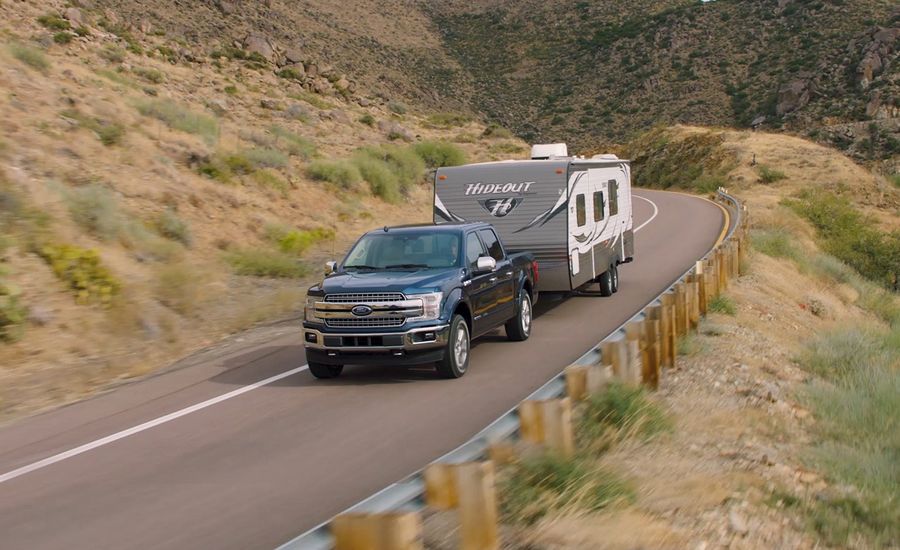
At long last, we got another King Ranch SuperCrew, this time with 6240 pounds of box trailer secured to the hitch. That is a robust load however almost two tons not as much as this present design's 10,100-pound most extreme tow rating. (The 11,400-pound max tow rating Ford promotes for the diesel is for normal taxi, two-wheel-drive XL models just.) This time we left on an alternate 23.5-mile circle of changed landscape, driving rapidly yet circumspectly—braking early, envisioning red lights, and keeping up the speed of activity. This truck was furnished with the 3.31:1 back differential, and you could feel it. As any individual who has trailered with a F-150 knows, it's a magnificent tow vehicle—it tracks straight, the influence control includes a level of security and solace, and it by and large makes towing far less demanding and more secure than you'd anticipate. Be that as it may, even before we hit the tough bits of the course (we began at 5420 feet above ocean level) the 3.0-liter diesel was working all day to keep up 55 mph, and even direct slopes were a foot-to-the-floor issue. It isn't so much that we were anticipating that it should perform with a Super Duty level of apathy, yet the emotional advances in the HD field in the course of the most recent couple of years may have unreasonably elevated our desires for the 3.0-liter Power Stroke.
Note that it never felt overemphasized in the way a fuel motor would when be able to pulling a heap tough, that sensation where the vehicle eases back to a degree that you start to mull over that you may not really make it to the best. The Power Stroke keeps up certainty the distance, faithfully if not abundantly. What's more, it never sells out its tranquil nature; the last Ram 1500 EcoDiesel we tried never let you overlook a diesel was in the engine. The dash showed a demonstrated 12.8 mpg for this trailer-towing portion. We're sensibly certain flatlanders will have no issue enhancing this figure, and we're on edge to perceive what sort of numbers we can post on a more drawn out course on our home turf.
New Math
There's no denying that the 3.0-liter Power Stroke is a cleaned entertainer. The rub comes when you begin to dive into the numbers decisively. Notwithstanding changing your mileage desires for taxicab and driveline varieties as beforehand nitty gritty, there's the little issue that the diesel's 11,400-pound max tow rating and 2020-pound payload rating isn't sufficiently even to make it the most proficient workhorse in the F-150 lineup. That respect tumbles to a legitimately outfitted F-150 with the 3.5-liter EcoBoost V-6 that is evaluated to tow 13,200 pounds and pull a 3270-pound payload. Additionally obfuscating the issue, the EcoBoost's tow appraisals are figured running premium fuel, which shuts the hole or sometimes totally nullifies the value advantage gas can have over diesel at the pump. Considering the underlying upcharge for the diesel motor, it's a numbers amusement best left to be played by customers with sharp pencils and strong utilization information.
Given the absence of a highly contrasting financial contention for the diesel and the way that Ford foresees it will represent only 5 percent of all F-150 deals, we think about whether affirmation is the genuine play here. Portage trusted to us before that the Dagenham, England, get together office where the 3.0-liter diesel is assembled has enough ability to surpass the present request; with both the U.S.- spec Ranger and another Bronco holding up in the wings, it's conceivable that Ford might be looking at the motor for use in those vehicles, as well.
Basically effectiveness is the objective here, not pulling-control matchless quality. In the event that you every now and again tow a direct sum over long separations, say a couple of snowmobiles or ATVs, or an utility trailer under 5000 pounds—and once in a while handle a short-pull, 7000-pound-in addition to towing work—the 3.0-liter Power Stroke diesel will give a lot of calm power and hypothetically enhanced mileage as time goes on. Be that as it may, in view of our short presentation up until this point, purchasers who consistently tow in excess of 6500 pounds over long separations would be ideally serviced by the 3.5-liter EcoBoost or ought to think about climbing to a Super Duty.
HIGHS
Smooth and direct power conveyance, calm activity, mileage.
LOWS
Less pull and torque than the 3.5-liter V-6 EcoBoost, value premium.
For significantly more profound scope of the Ford F-150, see our Buyer's Guide top to bottom audit.
In spite of the fact that it now wears a Power Stroke identification, the 3.0-liter V-6 has a universal family. Normally alluded to as the Lion motor, it was together created by Ford with PSA Peugeot Citroën years prior and is at present utilized as a part of some Land Rover items. We beforehand definite how Ford beefed it up for residential truck obligation, yet here's a short refresher: The square is a compacted graphite-press throwing, and new parts incorporate a produced crankshaft with particular pole and wrench direction and a variable-geometry turbocharger. The regular rail fuel infusion keeps running at 29,000 psi, while twin fuel channels and a double stage oil pump address immaculateness and oil issues. In spite of the fact that its 250-hp figure may appear somewhat feeble in the knees, it's the 440 lb-ft of torque that is important to the individuals who work their trucks hard. A 10-speed programmed is the sole transmission alternative. (A total summary on the new motor and transmission can be found here.)
The Price of Efficiency
Portage has made some clamor with the 3.0-liter diesel's as of late reported 30-mpg parkway EPA mileage rating (alongside 22 mpg city and 25 mpg joined), yet those numbers apply just to the back wheel-drive SuperCab. The well known four-wheel-drive SuperCrew design is evaluated at 25 mpg parkway, 20 mpg city, and 22 mpg joined—still noteworthy for a full-estimate pickup. For examination, the 2018 Ram 1500 EcoDiesel acquires a 27-mpg expressway evaluate for both two-and four-wheel-drive variations, yet the back drive Ram's 20 mpg city and 23 mpg joined appraisals trail the Ford's, as do the Ram 4x4's 19 mpg city and 22 mpg consolidated. (The overhauled 2019 Ram 1500 isn't putting forth the EcoDiesel amid its first model year, yet we anticipate that it will come back to the lineup soon.)
Going diesel includes some significant downfalls. In the Lariat trim, supplanting the standard 2.7-liter EcoBoost V-6 with the 3.0-liter Power Stroke diesel costs $4000; swapping out the King Ranch's standard 5.0-liter V-8 with the diesel is a $3000 upcharge, an overwhelming suggestion considering the solid, gas-consuming 3.5-liter EcoBoost V-6 can be spec'd for a similarly easy $600 (or $1600 on the Lariat). In the more essential XL and XLT models, the diesel is accessible for armada clients as it were.
Disregard the standard "for a diesel" qualifier, as we can state the 3.0-liter Power Stroke is only straight-up calm. Other than a little measure of obvious diesel bang at startup, little sign the motor inside does without start during the time spent burning. Clearly, standing specifically before the truck's grille or popping the hood will uncover the motor's actual nature, however as far as NVH in charge it sounds significantly more like an unassuming gas V-6 than an overwhelming hauler.
We tested a couple of various trims and designs furnished with the diesel, beginning off with a King Ranch SuperCrew 4x4 with 700 pounds of arranging supplies in the bed. Venture off is as sure as you would anticipate from a motor with 440 lb-ft of torque accessible at only 1750 rpm and coupled to a 3.55:1 back pivot proportion, yet you don't get the same redline-pursuing surge offered by the 2.7-and 3.5-liter EcoBoost V-6s. Exploring the winding two-path Highway 72 west of Broomfield, Colorado, to a height of in excess of 8800 feet above ocean level exhibited little test for the diesel. The 10-speed programmed transmission in its Normal mode—Sport, Eco, Tow/Haul, and Off-Road modes additionally are accessible—performed impalpably. On the other hand, with 10 gear-teeth to look over there's not a great deal of land in the middle of the proportions. The ride was amazingly smooth, controlled, and calm. Slipping the shifter into its manual mode enabled us to choose a rigging for ideal motor braking while at the same time moving down the mountain; tragically there is no fumes brake, discounting the likelihood of reveling our internal 10-year-olds with a fast and boisterous round of "huge apparatus about crazy" while getting a charge out of a hit the dance floor with gravity and force.
To perceive how a similar course would feel in an unladen truck, we snatched a delicately optioned Lariat SuperCrew with the indistinguishable powertrain and remembered our course. Of course, the evacuation of 700 pounds of counterweight in the bed made for a bouncier ride, however it was no livelier than some other current F-150. We changed to Sport mode and used an overwhelming foot to deliberately drive down the efficiency number for the length of the roughly 22-mile trip. In the wake of arranging at movement lights against arbitrary and totally absent contenders for a couple of off the cuff adjusts of Wide Open Throttle: F-150 Diesel Edition, we watched a completely sensible 21.8 mpg (showed) for the course.
Going romping in a SuperCrew outfitted with the FX4 Off-Road bundle had little to do with the diesel particularly other than featuring that it is so natural to balance the throttle at low speeds because of all that low-end torque. Simply keep up energy and let the four-wheel drive and discretionary electronic back locking differential win their keep.
At long last, we got another King Ranch SuperCrew, this time with 6240 pounds of box trailer secured to the hitch. That is a robust load however almost two tons not as much as this present design's 10,100-pound most extreme tow rating. (The 11,400-pound max tow rating Ford promotes for the diesel is for normal taxi, two-wheel-drive XL models just.) This time we left on an alternate 23.5-mile circle of changed landscape, driving rapidly yet circumspectly—braking early, envisioning red lights, and keeping up the speed of activity. This truck was furnished with the 3.31:1 back differential, and you could feel it. As any individual who has trailered with a F-150 knows, it's a magnificent tow vehicle—it tracks straight, the influence control includes a level of security and solace, and it by and large makes towing far less demanding and more secure than you'd anticipate. Be that as it may, even before we hit the tough bits of the course (we began at 5420 feet above ocean level) the 3.0-liter diesel was working all day to keep up 55 mph, and even direct slopes were a foot-to-the-floor issue. It isn't so much that we were anticipating that it should perform with a Super Duty level of apathy, yet the emotional advances in the HD field in the course of the most recent couple of years may have unreasonably elevated our desires for the 3.0-liter Power Stroke.
Note that it never felt overemphasized in the way a fuel motor would when be able to pulling a heap tough, that sensation where the vehicle eases back to a degree that you start to mull over that you may not really make it to the best. The Power Stroke keeps up certainty the distance, faithfully if not abundantly. What's more, it never sells out its tranquil nature; the last Ram 1500 EcoDiesel we tried never let you overlook a diesel was in the engine. The dash showed a demonstrated 12.8 mpg for this trailer-towing portion. We're sensibly certain flatlanders will have no issue enhancing this figure, and we're on edge to perceive what sort of numbers we can post on a more drawn out course on our home turf.
New Math
There's no denying that the 3.0-liter Power Stroke is a cleaned entertainer. The rub comes when you begin to dive into the numbers decisively. Notwithstanding changing your mileage desires for taxicab and driveline varieties as beforehand nitty gritty, there's the little issue that the diesel's 11,400-pound max tow rating and 2020-pound payload rating isn't sufficiently even to make it the most proficient workhorse in the F-150 lineup. That respect tumbles to a legitimately outfitted F-150 with the 3.5-liter EcoBoost V-6 that is evaluated to tow 13,200 pounds and pull a 3270-pound payload. Additionally obfuscating the issue, the EcoBoost's tow appraisals are figured running premium fuel, which shuts the hole or sometimes totally nullifies the value advantage gas can have over diesel at the pump. Considering the underlying upcharge for the diesel motor, it's a numbers amusement best left to be played by customers with sharp pencils and strong utilization information.
Given the absence of a highly contrasting financial contention for the diesel and the way that Ford foresees it will represent only 5 percent of all F-150 deals, we think about whether affirmation is the genuine play here. Portage trusted to us before that the Dagenham, England, get together office where the 3.0-liter diesel is assembled has enough ability to surpass the present request; with both the U.S.- spec Ranger and another Bronco holding up in the wings, it's conceivable that Ford might be looking at the motor for use in those vehicles, as well.
Basically effectiveness is the objective here, not pulling-control matchless quality. In the event that you every now and again tow a direct sum over long separations, say a couple of snowmobiles or ATVs, or an utility trailer under 5000 pounds—and once in a while handle a short-pull, 7000-pound-in addition to towing work—the 3.0-liter Power Stroke diesel will give a lot of calm power and hypothetically enhanced mileage as time goes on. Be that as it may, in view of our short presentation up until this point, purchasers who consistently tow in excess of 6500 pounds over long separations would be ideally serviced by the 3.5-liter EcoBoost or ought to think about climbing to a Super Duty.


Comments
Post a Comment